

How to Buy Skis: Cross Country Ski Packages
Similar to buying alpine skis, shopping for XC skis can be a little confusing, especially for those new to the sport. What width do you need? Do you need skate or classic skis? How long should they be? How long should your poles be? What’s the difference between NNN and NNN BC? If you’ve ever found yourself asking one of these questions, we’re here to help! In this article, we’ll touch on some key information you need to approach buying with confidence, then we’ll look at three different price tiers for different Complete XC Packages you’ll find here on SkiEssentials.com.
To start, while this is potentially over-simplifying things if you want to be really technical, an easy way to think about XC skis is to split them into three categories: skate, classic, and BC. Within those categories, there will be a lot of variety, particularly among classic skis. For instance, a BC (backcountry) ski is technically a classic ski as it used a classic stride to propel you forward. What puts a BC ski into a separate category is mostly the width of the ski. In skate skis, you’ll find less variety, and it’s largely based off price. Less expensive skate skis (and this is true for classic as well) will be easier to ski for a beginner, but slower overall. As you move up in price, the gear becomes closer and closer to what a World Cup ski racer would use, which are the fastest options, but can be unforgiving for a new skier.
Ski width is important for XC skis. This is where you should have a good sense of what you want to do on your skis as it will impact your decision. Do you want to skate? That’s easy. Generally all skate skis will be in the same width range in the 41-44 mm range. Luckily, you don’t have to worry much about width in your decision making. Classic, on the other hand, gets interesting. A groomed classic track like what you’d find at a cross country center is about 68 mm wide. That means if you want your skis to be able to fit into those groomed tracks, they need to be narrower than that. If you’re planning on spending most of your time in groomed classic tracks, realistically and ideally they should be considerably narrower than that. The most efficient classic skis, including race skis, will be in that same low 40 mm range like skate skis. A ski like the Rossignol OT 65 is a good example of a ski that physically can fit into a groomed track, but with its width and overall design, it’s not going to be very fast or efficient. Then there are a lot of things in between those race style skis and something like the OT 65, and within that range you can pick and choose what width and style ski will make the most sense for you. Once you get over 70 mm in width, we’re squarely in the BC category as those skis can no longer fit in groomed tracks.
There are a few other things you should be aware of before you start shopping. XC pole length can be a little confusing for some as it’s different whether you want to skate ski or classic ski. For skate poles, they are longer, and should come up to at least your chin and potentially as high as your nose. For classic poles, they should come up to about your armpits. It’s important to have the correct length poles for whichever discipline you’re doing, as unlike alpine skiing, your poles account for a considerable amount of your propulsion forward. It’s also important to know your boot size, although it’s generally easier than determining alpine ski boot size. Most XC ski boots will be sized in EU metrics, so simply converting your US shoe size to EU is all you need to do. Ski length is also quite easy to determine, but it’s important to do it correctly. XC ski sizes are based on skier weight, not height. That’s to ensure you have the correct flex, which is important on both classic and skate skis, but easier for most people to understand with a classic ski. If you’re too heavy, your kick zone or grip zone will come in contact with the snow too much, resulting in sluggish performance. If you’re too light, you’ll never get that kick zone in contact with the snow and will be struggling to go uphill. Each ski is going to have a weight range for each length, so it’s important to refer to the manufacturer recommendations.
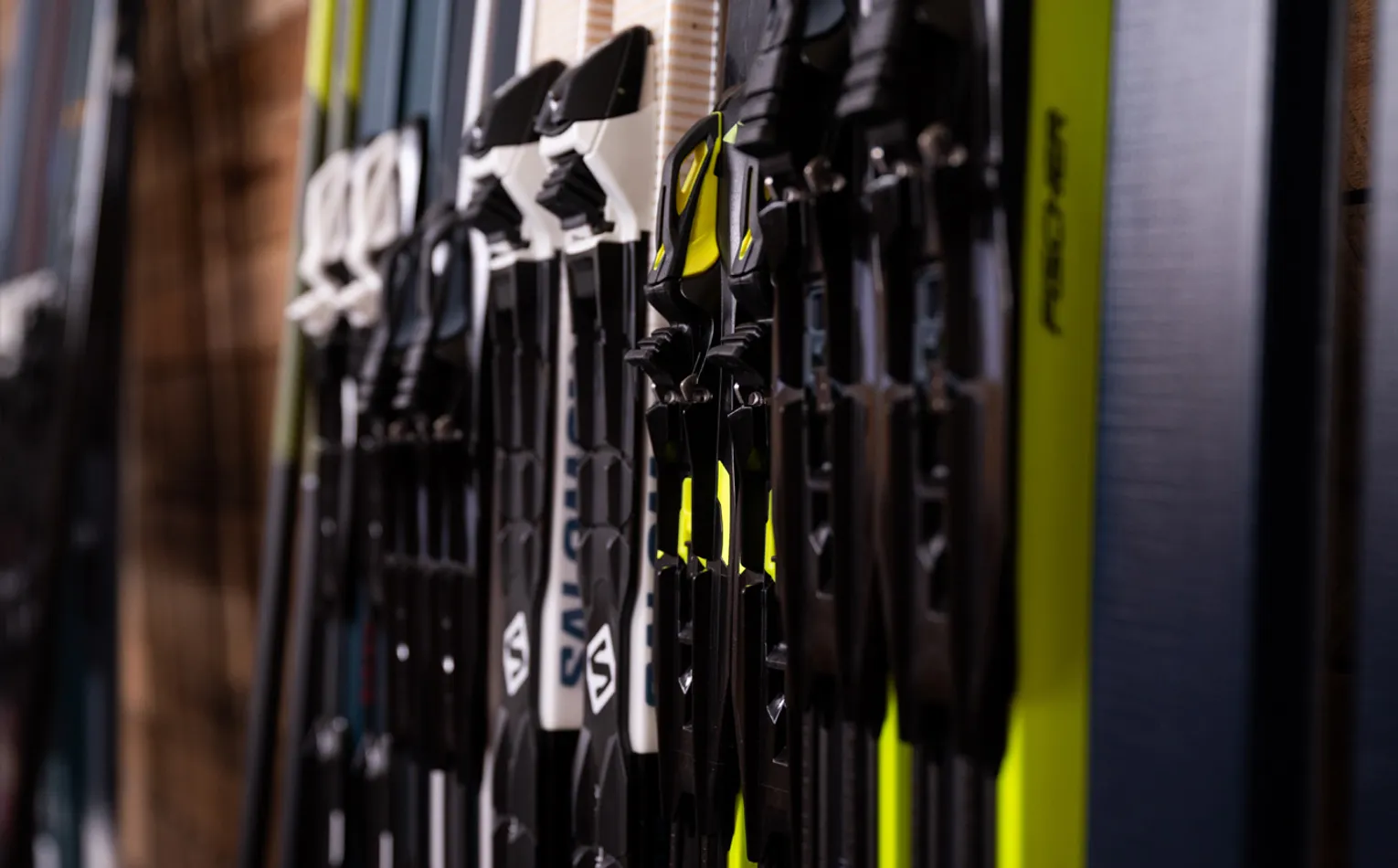
Fortunately, XC binding compatibility has become simpler in recent years, but there's still some variables to be aware of.
Last thing we’ll touch on is bindings. Luckily, in recent years, there has been some consolidating of different binding types and the process is much easier than it used to be. The main two types of bindings you’re going to find are either NNN or NNN BC compatible. This refers to the integration with your boot. XC boots will have a metal bar built into the toe of the boot, which connects to your bindings. There is a difference between skate and classic bindings, yes, but they’re integrations are both NNN. NNN BC is a wider, thicker metal bar that is used for backcountry boots and bindings. Typically, the selection process should be pretty easy, and if you’re shopping for a Complete Package, we make it simple by including an appropriate boot. It’s worth knowing, however, as you may already own boots. Previously, Salomon had their own SNS system that was not compatible with NNN. If you have old SNS boots, they’ll likely need to be replaced. Also, if you currently own NNN boots, but want to get backcountry skis, you’ll almost definiyely need new boots.

Entry Tier:
These first price tier Complete XC Ski Packages are all under $450, which includes your skis, bindings, boots, and poles. Cross Country skiing is a fantastic activity in general as compared with alpine skiing, the associated costs are much lower. $450 and some athletic outdoor clothing and you can go skiing. While some cross country centers do require a trail pass, it’s a fraction of the cost of a lift ticket and between golf courses, rec fields, local trail networks, and more, there are plenty of places to go ski for free.
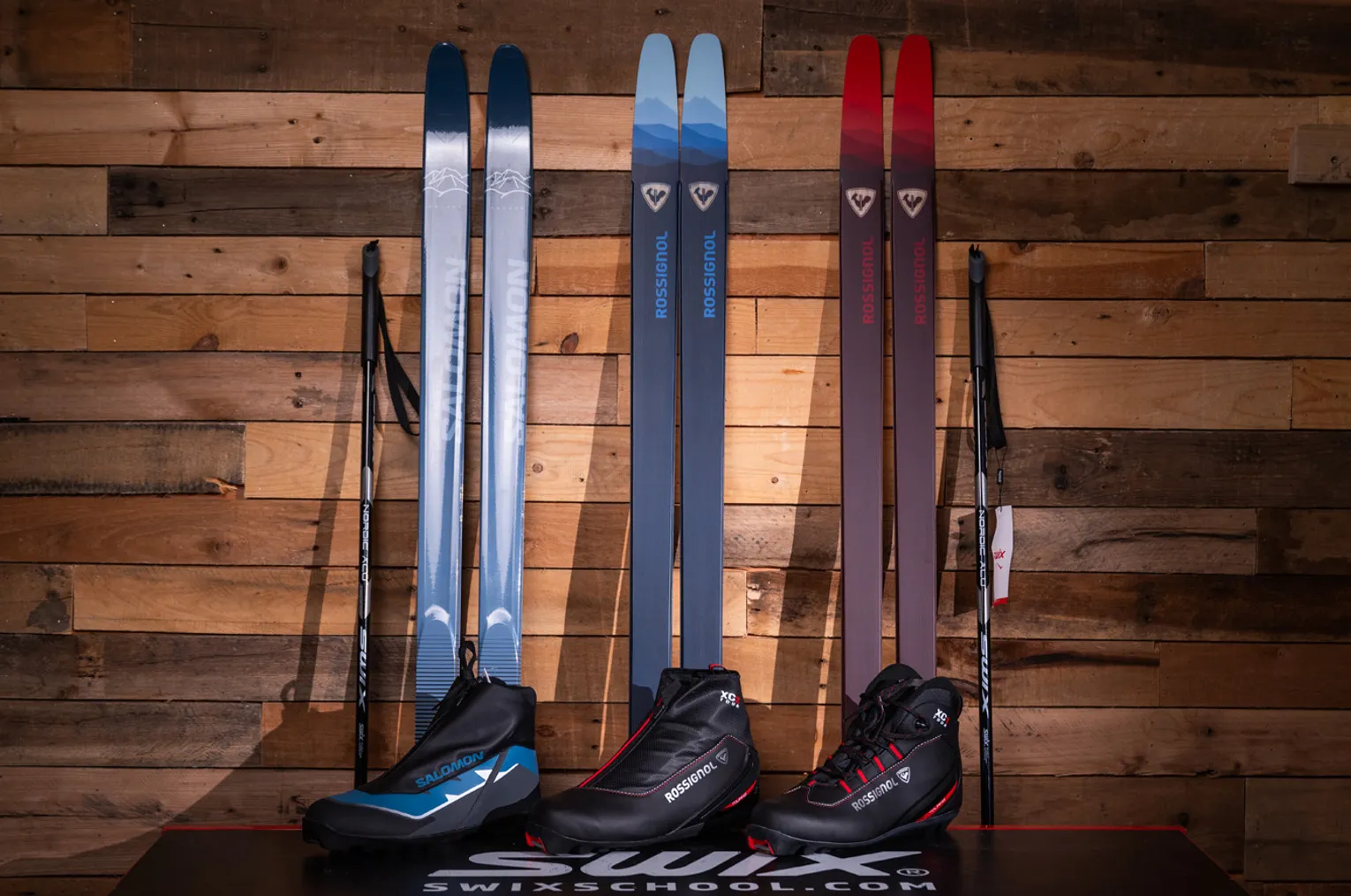
All three of these packages are fantastic for skiers looking for the least expensive options as well as skiers who are new to the sport. All of these skis are classic skis, which truthfully is the best place to start. If you’re new to XC skiing, going straight to skate skis isn’t recommended. Also, these three options are all versatile widths. They’re narrow enough to fit into groomed classic tracks, yet have enough width to feel stable and predictable if you’re going off trail. All three also use waxless, Positrack or Posigrip bases (manufacturer terms). The most common term to describe these bases is traditionally a “fish scale” base. While the industry has seemingly drifted away from using that term, most people are still familiar with it. These bases have excellent grip, don’t require the use of kick wax (we’re actually never going to recommend using kick wax in this article!), although they are on the slower side when it comes to glide. That said, a new skier shouldn’t be worried about how fast their skis are. You’ll benefit much more from the extra grip when going uphill.
That said, there are some differences too! If you think you’ll be spending most of your time at a groomed XC center with classic tracks, the EVO XT 55 will be the best choice. They’re going to be the most efficient and the fastest, while still being very, very easy to ski. The EVO XT 60 and the Salomon Escape Snow 59 are both slightly wider and are a better choice for someone who knows they’re going to be going off trail more often, but still wants the potential for use in groomed tracks. They are extremely well-rounded skis that are easy to ski and both are fantastic choices for someone who’s not sure what they’re going to be doing and are just looking to get their feet wet in the sport (figuratively speaking, of course).
2025 Salomon Escape Snow 59 Posigrip Skis w/ Salomon Escape Prolink Boots and Poles
Price: $389.95 | Buy Now
2025 Rossignol Evo XT 55 Skis w/ Rossignol XC 1 Boots and Poles
Price: $439.95 | Buy Now
2025 Rossignol Evo XT 60 Positrack Skis w/ Rossignol XC 2 Boots and Poles
Price: $429.95 | Buy Now
Mid Tier:
Moving into the second price tier, and luckily, the prices don’t rise much! We’re basically in the $500-600 range with these five packages, and we start to see a little more variety and more focused performance into different disciplines. We see overall boot quality and performance improve as well. So, while you’re not spending considerably more, in theory you can gain a lot of performance in this second tier. What’s important to think about is whether you need it or not. If you’re genuinely new to the sport, staying with the first price tier very well might be the way to go. If you have a clearer picture of what you want to do on your XC skis and you have some experience under your belt, however, there are certainly benefits here.
The Rossignol EVO XC 60 R-Skin is the same shape as the EVO XT 60, but has a higher quality wood core, fiberglass stringer, a more energetic flex pattern, and also uses a skin grip system rather than the Positrack. When talking skins in the XC ski world, it’s much different than alpine touring skis, until you get into much wider BC skis, that is. These skin systems are much, much smaller than what you’d see on an alpine ski just being located underfoot. It’s basically the same exact spot as where you would traditionally apply kick wax. Compared to the Positrack base, it’s much shorter. When you add in the more energetic flex pattern, in order to achieve grip while going uphill, the skier has to have better technique and more precise weighting compared to a ski like the XT 60. So, if you have some experience and a good classic stride, you can benefit from a ski like this from its more efficient nature. On the other hand, if you’re new to the sport, it can be frustrating as you struggle to find grip. Aside from that, it’s a similar application. Narrow enough for classic tracks, wide enough to go off trail. It’s much more a matter of skier ability and what you want out of your skis, rather than where you want to go skiing.
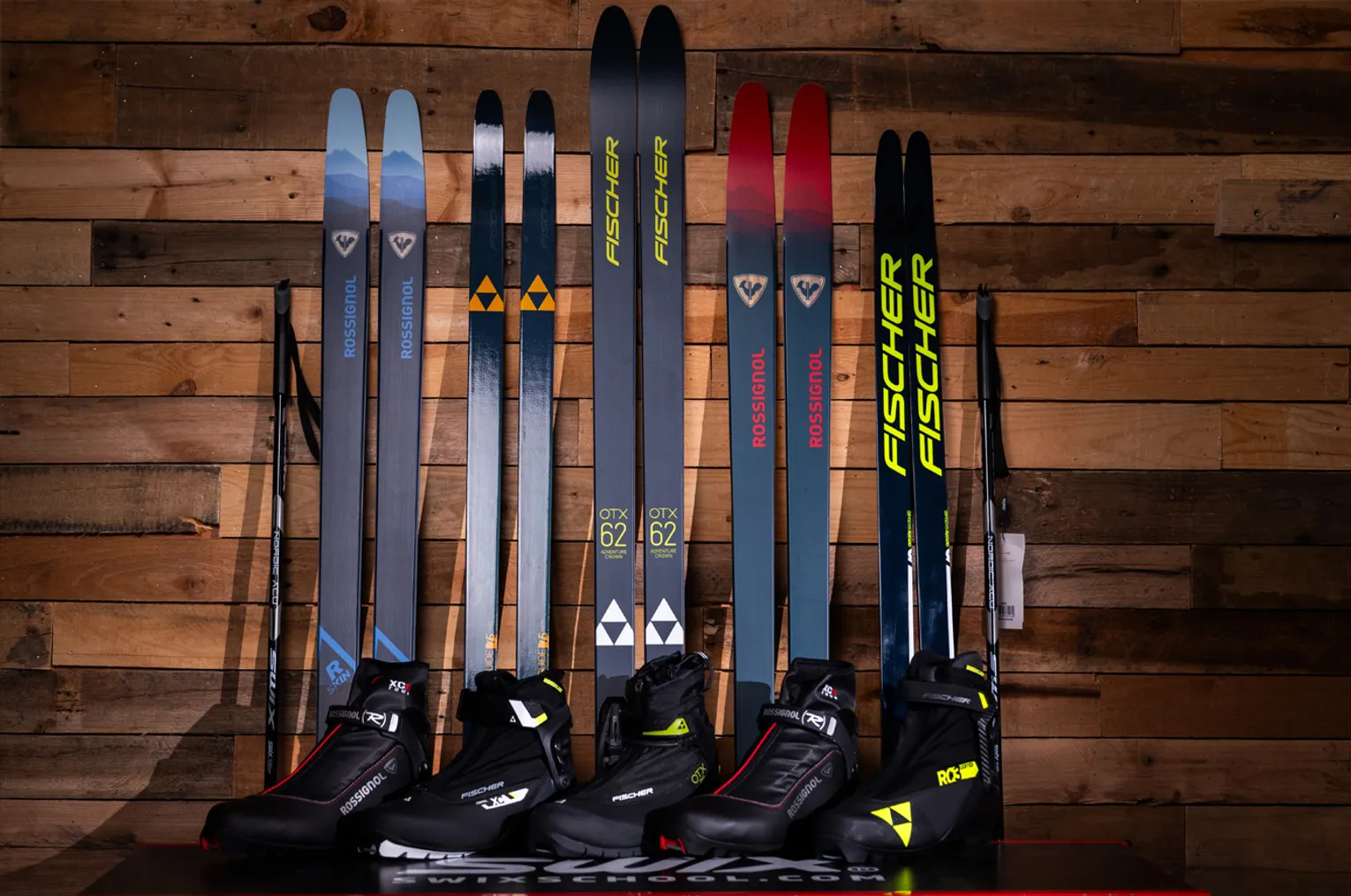
Going wider into the Fischer Adventure 62, the skis are starting to be more focused on off trail use. The Fischer OTX Trail boot provides a lot of support in the upper cuff, which comes in handy if you’re skiing variable snow and ungroomed surfaces. Off-Track Crown is a fish-scale-style grip system that’s designed to maximize grip and stability off trail, but won’t be nearly as efficient as the R-Skin on the XC 60 in a groomed track. In other words, these skis are slower, but more stable and with more grip overall. They will still work in a groomed classic track, but you’re really starting to lose some efficiency.
Then moving even wider into the Rossignol EVO OT 65, this is where I personally draw the line for use in a groomed track. While 65 is technically narrow enough to fit, it starts to come in contact with the sides of the groomed track more often and honestly just doesn’t feel very good. That’s fine, however, as this ski truly is designed to go off trail. You get a big fish-scale-style base that’s paired with a partial metal edge underfoot. Any time you see a metal edge on a cross country ski, it’s a good indication it’s not meant for groomed tracks. On the other hand, the OT 65 is a fantastic option for those just going out their front door and exploring fields, trails through the woods, golf courses, and really any other situation where you’re skiing natural snow. There is a limitation on the other end, as these skis aren’t intended for true backcountry use, but they share many characteristics with wider BC skis.
Then we get some skate skis! Both the Fischer Aeroguide Skate 75 and the Fischer Aerolite Skate 60 pack a ton of value. As someone who raced nordic 20 years ago, the performance of these skis is jaw-dropping to me considering the price. The Aeroguide Skate 75 is, in many ways, a new option for the market in general. These skis actually have a little bit of sidecut with the tips and tails being wider than the waist of the skis. That may seem like it would be obvious, but most skate skis are actually shaped more like a javelin than an hourglass. The little bit of sidecut helps skiers keep control over their skis, which can be tough for those just learning how to skate. It’s a really cool option to have and is highly recommended to true beginner skate skiers. The Aerolite Skate 60 is about $100 more and the performance does tick up a notch as well, but they’re not as intuitive for a new skier. These skis are great for someone with experience skating and who want a performance oriented ski, but are looking for value as well. These are the kind of skis that blow my mind thinking back to what I raced on 20 years ago. The performance is incredible for the price, and while it’s not going to be as fast as a race ski, it’s not far behind. Both of these, and I would say especially the Aerolite 60, are great choices for the fitness oriented XC skier who is really looking to log some kilometers.
2025 Rossignol EVO XC 60 R-Skin Skis w/ Rossignol XC 5 Boots and Poles
Price: $489.95 | Buy Now
2025 Fischer Aeroguide Skate 75 Skis w/ Fischer XC Control Boots and Poles
Price: $499.95 | Buy Now
2025 Fischer Adventure 62 Crown Xtralite Skis w/ Fischer OTX Trail Boots and Poles
Price: $499.95 | Buy Now
2025 Rossignol EVO OT 65 Skis w/ Rossignol XC 5 Boots and Poles
Price: $589.95 | Buy Now
2025 Fischer Aerolite Skate 60 Skis w/ Fischer RC 3 Combi Boots and Poles
Price: $589.95 | Buy Now
Top Tier:
Moving into the third price tier, we will see some improvements in performance and quality as well as the inclusion of true backcountry gear. While you can certainly spend more than this, these packages perform at a level that will satisfy even very experienced skiers. Often times, there’s no need to go above this range. Of course, if you’re racing or have very specific goals and demands, it can be worth spending more. Simply put, however, the performance to price ratio here is, in my opinion, very impressive.
Starting with the Fischer Aerolite 80, you spend more than the Aerolite 60, but you get a faster ski, World Cup level technology, and a higher performing skate boot with better upper cuff support. In my opinion, this level is perfectly appropriate for a high school ski racer, someone doing casual adult races, and skiers who want speed and efficiency for fitness goals. I am quite sure someone would tell me I’m wrong about the high school race level and that those serious about the sport should have faster skis, and while you might be right, ski racing is expensive and I think this package would be great for most high school racers. If you’re going to nationals, that’s one thing. If you’re doing it for fun and to better yourself, it’s a great choice.
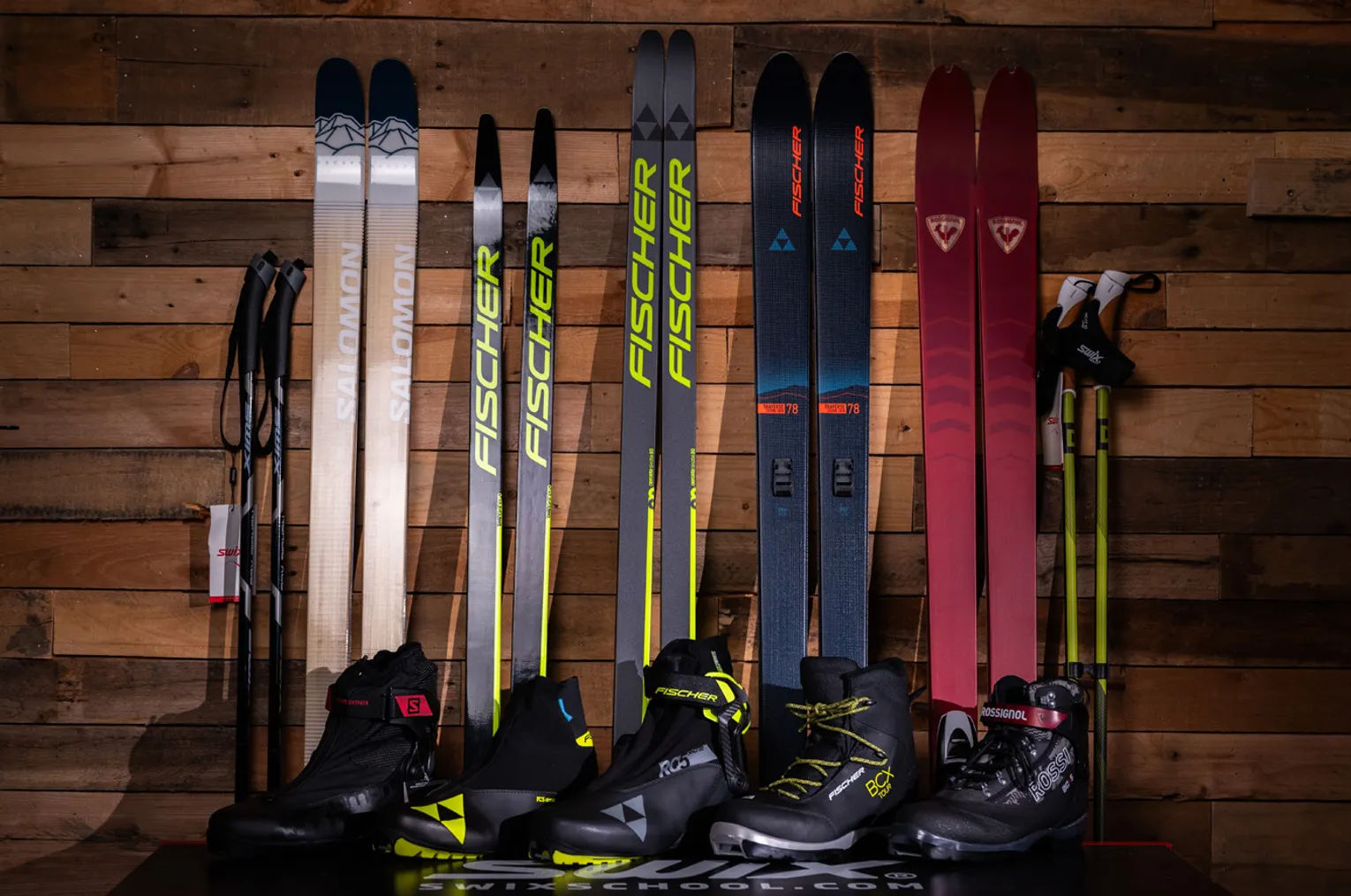
The Fischer Twin Pro is an extremely comparable classic ski to the Aerolite 80. At a similar price, you’re getting similar performance, and these skis are way faster than any other classic ski we’ve looked at in this article. The twin skin technology is super fast, yet provides impressive grip for someone with good technique. In comparison to other classic skis we’ve looked at, however, these should be used only in groomed tracks. While you could ski them in ungroomed terrain, their narrow shape isn’t going to perform well and really the ski is optimized for efficiency in a cross country center with groomed trails.
Moving into the Salomon Escape Outpath 64, this ski kind of barely made it into the third price tier here, and realistically is quite similar to the EVO OT 65, but what I thought was worth pointing out at this slightly higher price level is the quality of the boot. The Outpath Boot from Salomon is impressive. It has great performance for the price and has many features that come in handy if you’re skiing off trail and in softer snow conditions.
Finally, the Fischer Traverse 78 and the Rossignol BC 80 are our only two true backcountry skis in this article. Not only are these skis much wider, and will no longer fit into groomed classic tracks at all, they also both move to NNN BC boots and bindings. These are specifically designed for skiers who want to explore off trail terrain. They’re getting close to the capabilities of alpine touring skis, although still squarely in the cross country category. You lose out on a lot of efficiency for kicking and gliding, but you gain stability in variable terrain and conditions, you gain float for soft snow, and you gain grip on firm terrain thanks to metal edges. It’s always important to keep in mind, however, that if you go with a package like this, you won’t be able to use the boots in all the narrower skis we’ve discussed, nor vice versa.
2025 Salomon Escape Outpath 64 Skis with Salomon Escape Outpath Boots and Poles
Price: $629.95 | Buy Now
2025 Fischer Twin Pro Medium Skis w/ Fischer RCS Classic Boots and Poles
Price: $739.95 | Buy Now
2025 Fischer Aerolite Skate 80 Skis w/ Fischer RC5 Skate Boots and Poles
Price: $739.95 | Buy Now
2025 Fischer Traverse 78 Crown Skis w/ Fischer BCX Tour Boots and Poles
Price: $587.99 | Buy Now
2025 Rossignol BC 80 Positrack Skis w/ Rossignol BC X5 Boots and Poles
Price: $619.95 | Buy Now
There’s a lot of information here and hopefully it’s not further complicating the process. As always, with any gear you might be considering on SkiEssentials, don’t hesitate to leave a question or comment, chat with our customer service staff, or give us a call. We’re happy to help you choose the XC skis that are right for you!